
The S&P BSE Sensex dropped 1 points to end at 26,396 and the Nifty50 slipped 2 points to end at 8,109.

'Investors need to be stock specific and should not rush to buy stocks at the current levels.'

Bajaj Finance was the top laggard in the Sensex pack, slumping over 10 per cent, followed by M&M, Titan, Hero MotoCorp, ICICI Bank and Tech Mahindra. On the other hand, L&T, Bharti Airtel, IndusInd Bank, UltraTech Cements and NTPC were among the gainers.

In India, it is not easy to fight it out with the large banks which are nimble-footed and technology-savvy and are continuously innovating on the retail turf with newer products for customer acquisition.

The Nifty ended at 5,060, down 94 points.

PowerGrid, Tech Mahindra, Infosys, Nestle India and HCL Tech too ended with losses.

Top seed Koneru Humpy could not get the better of Shen Yang's defence and settled for her second draw on the trot to slip to the joint third place after four rounds in the IS Bank Ataturk Women Grand Prix chess tournament now in progress in Istanbul.

Top losers in the Sensex pack included SBI, HDFC twins, Bajaj Auto, ONGC and Tata Steel, falling up to 2.49 per cent.
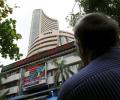
SBI, PNB, Bank of Baroda, Canara Bank, Dena Bank, Central Bank of India ended down 3%-12% each.

HCL Tech was the biggest loser on the Sensex chart, shedding 2.79 per cent, followed by Tata Steel, ICICI Bank, Reliance Industries, ITC, Wipro, Infosys and M&M. In contrast, Tata Motors, L&T, Bharti Airtel, HDFC Bank and SBI were among the winners, climbing up to 2.05 per cent.

According to bankers and economists, there is room for further rate cut by the RBI as retail and wholesale inflation rates have remained benign.
The regulatory actions, undertaken by the RBI and the government, came hours after finance ministry sources confirmed that SBI was directed to bail out the troubled lender. For the next month, Yes Bank will led by the RBI-appointed administrator Prashant Kumar, an ex-chief financial officer of SBI.

The stock of State Bank of India (SBI) may re-rate soon, believe analysts, if the lender manages to safeguard its net interest margin (NIM) going ahead. This, along with controlled credit costs, should aid the outlook of the stock which has been underperforming the markets for some time now. "We believe delivery of growth on guided lines, sustenance of NIMs near current levels, and controlled asset quality parameters aiding controlled credit costs should lead to strong profitability and drive re-rating of the stock," said analysts at JM Financial.

Oil edged up on Tuesday, steadying after a 5 per cent plunge in the previous session that saw prices touch fresh 5-1/2-year lows in an oversupplied market.
In the Sensex pack, Asian Paints, Larsen & Toubro, Titan, IndusInd Bank, Bharti Airtel, Power Grid, Bajaj Finserv, Infosys, HDFC Bank and HDFC were the major laggards. On the other hand, Axis Bank, Tata Motors, ITC, State Bank of India, Tata Steel and Sun Pharma were among the gainers.

Tata Motors was the biggest gainer in the Sensex pack, rallying 2.94 per cent. It was followed by Vedanta, Bajaj Finance, Sun Pharma, ONGC, ICICI Bank, Bajaj Auto, Tata Steel, RIL, HDFC duo, L&T and SBI, rising up to 2.78 per cent.
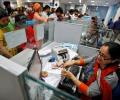
RBI said the improvement in asset quality was driven by state-run lenders which saw a drop both in both GNPA and in the net NPA ratios.
India has slipped three positions to 134th spot in the latest ease-of-doing business list, which is topped by Singapore, according to World Bank.
HCL Tech was the top loser in the Sensex pack, dropping 1.80 per cent, followed by Reliance Industries, HDFC Bank, TCS, Tech Mahindra, L&T, Maruti, Bajaj Finance and HDFC.

Nine of the 10 most valued firms faced a combined erosion of Rs 1,87,808.26 crore in market valuation last week, with HDFC Bank and Reliance Industries taking the biggest hit amid an overall weak trend in equities. Last week, the BSE benchmark tumbled 1,538.64 points or 2.52 per cent amid concerns that the US Federal Reserve might raise interest rates further to curb inflation. Fresh foreign fund outflows also dented investor sentiments. Barring ITC, all 10 firms, including Tata Consultancy Services (TCS), Infosys, ICICI Bank and Hindustan Unilever, were the laggards.

The writing has been on the wall for some time. Exodus of senior leadership and growth behind its peers are reasons that have prompted Thierry Delaporte, the chief executive officer (CEO) of Wipro to resign, analysts said. Delaporte, Wipro's seventh CEO, also resigned without completing his five-year term, like his predecessor Abidali Neemuchwala decided to end his tenure prematurely in 2020. Phil Fersht, HFS Research CEO and chief analyst believes the change in leadership was at least six months overdue.

The broader NSE Nifty went up to a fresh life-time high of 10,494.45, but failed to stay on the top as it slipped and closed down 19 points, or 0.18 per cent, at 10,444.20.

Among the main gainers were Jio Financial Services which jumped 4.99 per cent, Tata Steel (2.09 per cent), Maruti Suzuki (1.87 per cent), M&M (1.31 per cent) and Infosys (1.19 per cent).

Market breadth depicted gains with 1,476 advances over 1,403 declines on the BSE. 140 stocks remained unchanged.

Equity benchmark indices Sensex and Nifty stayed on the back foot for the second straight session on Friday as investors offloaded FMCG, IT and teck stocks amid a weak opening in European markets. Selling pressure in index heavyweight Reliance Industries also added to the weak trend in equities. The 30-share BSE Sensex fell 223.01 points or 0.35 per cent to settle at 62,625.63.

The general elections in April/May 2024 are expected to add volatility to the Indian markets, keeping investors on their toes.

Among the Sensex firms, Asian Paints, Tata Steel, HCL Technologies, Nestle, Maruti, JSW Steel, NTPC and Larsen & Toubro were the major laggards. Sun Pharma, Bajaj Finserv, Reliance Industries, State Bank of India and Bharti Airtel were the gainers.

Wall Street-correlated stock markets are facing the risk of correction, as Christopher Wood, the global head of equity strategy at Jefferies, conveys to investors in his latest edition of GREED & fear. Rising crude oil prices, which are nearing $100 a barrel (Brent), pose a threat to the global central bank's battle against inflation and have led to a re-evaluation of its exposure to Indian stocks. "The potential for more US Federal Reserve (Fed) rate hikes, combined with the risk that monetary tightening finally bites as regards the economy, remains a risk for Wall Street-correlated world stock markets. "There is also the oil factor. This is why GREED & fear continues to believe the pain trade is down. "Areas in Asia, such as Indian midcaps, which have already done very well, are at obvious risk of some profit-taking," writes Wood.

India's manufacturing sector activity witnessed a significant loss of growth momentum in May due to the intensification of the COVID-19 crisis and its detrimental impact on demand, a monthly survey said on Tuesday. The seasonally adjusted IHS Markit India Manufacturing Purchasing Managers' Index (PMI), fell to 50.8 in May, down from 55.5 in April, as companies observed the slowest rises in new work and output in ten months amid intensification of the COVID-19 crisis. In PMI parlance, a print above 50 means expansion while a score below 50 denotes contraction.
Other major laggards were IndusInd Bank, SBI, Bharti Airtel, ONGC, Tata Steel and Reliance Industries -- falling as much as 6.30 per cent.

Unlike the earlier experience post the global financial crisis, where nearly 90 per cent of the restructuring happened in the corporate loans, the non-corporate segment, which includes small businesses, agricultural loans and retail lending, will account for a higher share this time.

The domestic equity market on Thursday snapped the five-day losing streak as the benchmark Sensex recouped its lost ground and closed 78 points higher on fag-end value buying in banking, energy and financial stocks. A positive opening in the European market helped the investor sentiments even as clouds hovered over the health of the global banking system amid Credit Suisse woes and bank failures in the US. Halting its five-day losing streak, the 30-share BSE benchmark rose 78.94 points or 0.14 per cent to close at 57,634.84 points, with 17 of its constituents ending in the green.
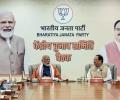
'BJP has lot of money. Even a rich person like me is scared of taking on the financial muscle of the BJP.' 'What is the point of throwing money? Result toh aane wala nahi hai.'
India now has three companies in the global top 100 list in terms of market value: Reliance Industries (RIL) ranks 72, Tata Consultancy Services (TCS) is at 86 and HDFC Bank at 99.


Billionaire Mukesh Ambani's Reliance Industries has maintained its highest ranking among Indian corporates in the latest Fortune Global 500 list, jumping 16 places to rank at number 88. Reliance was ranked at number 104 in the 2022 ranking and in the 2023 ranking it is placed at number 88, according to the publication. The company has gained a whopping 67 places in the last two years from number 155 in 2021.

Chinese shares opened lower, with the Shanghai Composite Index down 1.8% and the CSI300 index down 2.2%.

'What happens in the real estate market is that once the prices go up it goes on to stay at that level.' 'It might not increase and at the same time the prices will not come down too.'

Tata Steel was the top loser in the Sensex pack, shedding 3.01 per cent, followed by M&M, Maruti, Asian Paints, PowerGrid, ITC and Axis Bank.

Its total income during the September quarter also slipped to Rs 30,191 crore, as against Rs 32,435 crore in the year-ago period
